|
In the video below, you can hear Moretz talking about:
* Why she keeps being drawn to horror movies going back to her first movie The Amityville Horror
* Working with Julianne Moore as her overprotective mother
* How this is going to be gorier and more violent than the original movie
* The fact they can go further than Brian De Palma did with his movie
* How she had her first high school experiences making the movie
She also talked a bit about Kick-Ass 2, the sequel to the adaptation of Mark Millar and John Romita Jr.'s graphic novel, which she's three weeks into shooting, particularly about going back to the character she played when she was considerably younger:
"I'm not going back in time, which is good. I'm growing up with this, so it's just an older sophisticated version of Hit Girl and we don't take away who she was but you see Mindy more in this movie and you see her struggle with who she is and try to figure out what she likes, if she likes this, if she likes that, who is she? It was really funny because I only had a weekend off in between 'Carrie' and 'Kick-Ass' so I went from wearing blood every day of my life for the last three weeks of shooting 'Carrie,' to starting 'Kick-Ass.' The first thing I shot was me in full Hit-Girl mode, knives, guns… it was so anti-climactic to go from being this really heartbroken character to be this strong, powerful woman."
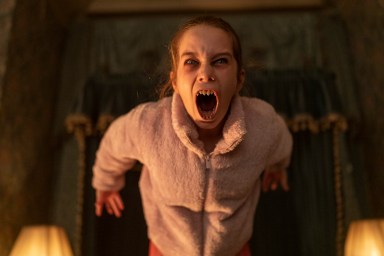
After our interview, we attended the Carrie panel in the IGN Theater, moderated by Dalton Ross from EW. They started off by showing the brand-new teaser for the film, which showed the camera panning through the town that's been decimated and completely on fire and we hear a voice talking about what happened with someone saying that her mother was a fanatic and it was like something supernatural. The last person says, "She wasn't a monster, she was just a little girl," and then we cut to Moretz as Carrie, covered in blood and looking very angry.
Ross was joined by Moretz, Julianne Moore, director Kimberly Peirce and producer Kevin Misher, and he actually spent much of the panel asking his own questions.
"I didn't take anything from his movie," Peirce said about the original, after mentioning she had been in touch with original director Brian De Palma and had become friends with him. "For me, it was reading Stephen King's absolutely fantastic novel, falling madly in love with his depiction of Carrie, Carrie's mother and all the other people in the story and just thinking, 'My God, this is such a fantastic story, I need to bring this to life' and I need to bring it to life in a modern way as it would be done now, just because it's so much fun and it's so great. That's always what I went back to and we were so lucky to have this wonderful cast, Chloé and Julianne, and they always took us right back to the book. They share this love for King's novel so we were not only able to go back to the novel but inhabit it in a way that's so fantastic."
Producer Kevin Misher said that the book was an extraordinary resource, and going back to the book, the destruction of the town was much bigger than in the movie, and that they had an opportunity to do things they couldn't do back in the day technology.
For Moretz, she's following in the footsteps of Sissy Spacek, who was nominated for an Oscar for her performance of Carrie White in the original movie, but the 15-year-old tackled the role just like she would any other one and tried not to think about it. "Everyone always asks me, 'Are you going to live up to Sissy's character and the original movie?' I don't know. I loved the original movie, but you have to be completely secure in what you're doing and what you're putting on screen. I have to think about it like any other movie. It's a movie, a script and a character you love and you really want to go into it, so you do the same you do on any other film, because that's just your process. You just have to be completely confident in what you're doing or else you'll tear yourself apart."
"I think that's what's so exciting about working with Chloe because she's an actual adolescent," Moore backed her up. "Sissy, who was so wonderful, was 26 at the time when she made the original 'Carrie,' so here's someone who is actually a teenager in a story about being a teenager. That, to me, was incredibly lucky to have someone who was in that stage of life.
Unfortunately, because Carrie is a remake, most of those involved with making the movie will spend a lot of time justifying its existence, as Peirce added, "I think the other thing to think about is there's lots of room in terms of bandwidth of ideas, so let's say they made a great movie and those performances are fantastic, but it doesn't have to take anything away for this to be completely modern with two new people. There are a number of things we're able to do now which for a lot of reasons weren't done then. They really can exist as two separate, equal, incredibly great things, that's what I like to think. Ours is just naturally its own thing, and it's really been one of the most rewarding fun crazy experiences, but I have to say that the mother-daughter relationship in the movie is profound and it really is the heart and soul of our entire story."
Moore talked about the motivations for her character, Margaret White, saying that she also drew from the book. "For me, she was somebody who moved away from her family and joined a religious sect and formed her own religious sect with her husband and then he died. She thought when she was pregnant that the child was a cancer and then delivered the baby alone, so all that backstory is in the novel. So I thought that means her only family, her only sense of community, is this child Carrie, So it's really about her trying to keep that as intact as possible. The minute Carrie starts moving away from her, she senses this real danger and wants to parent her. So she does this out of a sense of love and family and her desire to keep her there, but it's not conducive."
Both Moore and Moretz talked about how they created the mother-daughter relationship, which had the older actress making the younger one feel comfortable for the more intense scenes.
"The biggest thing is how much blood," Peirce said about the challenges of making a horror movie, being best known for dramas like the Oscar-winning Boys Don't Cry and Stop-Loss. "There was probably R'n'D for three or four months, there was like fifty blood dumps, and it was, 'Is it three, four or five gallons? Is it thin or thick? Do we dump it from here, do we dump it from there?' I have to tell you guys, and you won't want to try this at home, but most of the times you're going to miss or you'll hit their shoulder or wig. And the thing was 'Is it going to hit her on the day?'" She estimated that they used a thousand gallons of fake blood while making the movie, including the tests.
"Also, no actual pigs were harmed in the making of this movie," Misher joked, while also confirming that it was going to be an R-rated movie so you could depict the work from King's book accurately and didn't have to pull any punches. King himself hasn't been involved in the movie since he tends to take a hands-off approach when it comes to people adapting his novels.
Moretz talked about what was it like being covered in blood. "It was probably the most fun for about the first two weeks of it and after that, it got sticky and wet and it was 40 degrees, but each day, the blood became something else. We had the wet blood and the fire blood and the dry blood and all different kinds of blood. Each day, the blood became part of who you are and I got used to going home every night covered in blood."
Once they went to questions from the audience, Kimberly talked about how social media and modern-day bullying would be used in the movie. "I'm very character and story driven so I fell in love with who Carrie was and what she was going through and all these relationships and really wanted to bring that to life. The idea of bullying, certainly there is a wide awareness of it since the time when De Palma made his movie and Stephen King wrote his book, so I certainly think in some of the scenes there's an awareness by the teachers in school, that these phenomena happen and they need to be more aware of it. I can't give away plot details but we have a really fun and dangerous throughline about something one of the girls does with some social media that builds and builds until it climaxes until the end, but that's just a representation of the modern world and what people are going through."
Oddly, the teacher at Moore's kids' school was in the audience and he also asked about that aspect of the plot and how they're dealing with how the victims of bullying are sometimes depicted as perfect and undeserving of the bullying. Julianne Moore talked about Stephen King's book on writing and how he talks about how he was influenced by two isolated girls he went to school with to write the original novel. "We're not making a polemic here," she said, agreeing with what Peirce said. "We're making an entertaining movie about adolescence and power and growing up, but in it, we're reflecting something that happens in society and in schools. These people are flawed and that's really important. You're seeing a very flawed mother, you're seeing high school students who are confused and conflicted. You see Sue Snell who tries to do better and ends up making everything worse, but I think one of the great things about Stephen King and this story is that it allows us to participate in many different ways and reflect on it rather than come up with an answer."
Peirce continued with that idea. "When you're developing a character, you don't want the person who is going to get hurt in the building to be perfect and be all innocent. She has to be complicated so you're engaged, but also, the mother has her flaws and then Sue Snell makes the wrong decision and then Chris, the girl who is perpetrating it, you also have to find the other side of her, which is where is her vulnerability and her innocence and why does she keep doing it? That's one of the biggest questions we look at from the beginning, which is how does this girl who starts throwing tampons graduate to killing a pig and dumping pig's blood, and keep the character active as if she has a whole other side to her. They all need to be dimensional and then you're pulled into the story and that's more what life is like anyway. Also, you want to go on the journey and see why it keeps escalating."
Before wrapping the panel, they pimped the phone number you can call for the promotion "Call Carrie's house," which is 207-404-2604, saying that you could get Julianne or Chloé on the phone as their characters.
Carrie is scheduled for release on March 15, 2013.
Stay up to date with the latest horror news by "liking" Shock Till You Drop's Facebook page and following us on Twitter! |